
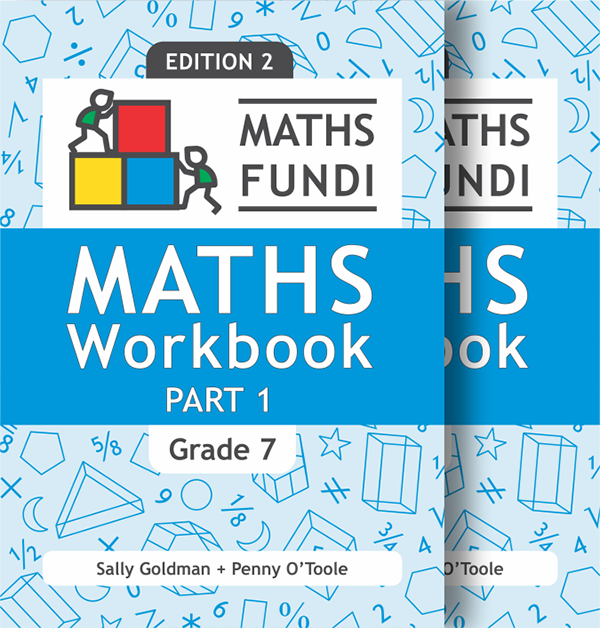
Maths Fundi Workbook – Grade 7
in 2 parts + separate detailed Answer Book
Sample Pages


Print ISBN:
978-1-7764055-5-8
Edition 2:
July 2022
Part 1: 98 A4 pages
Part 2: 122 A4 pages
19 chapters
Study Guide Table of contents Grade 7
Content Area 1: Numbers, Operations and Relationships
Chapter 1 Whole Numbers
| 1.1 | Number Systems |
| 1.1.1 | Roman Numerals |
| 1.1.2 | Hindu-Arabic Number System |
| 1.2 | Number Concept |
| 1.2.1 | Place value |
| 1.2.2 | Terminology |
| 1.2.3 | Number lines |
| 1.2.4 | Rounding off |
| 1.3 | Multiples, Factors and Prime Numbers |
| 1.3.1 | Multiples and LCM |
| 1.3.2 | Factors and HCF |
| 1.3.3 | Prime and composite numbers and 1 |
| 1.3.4 | Prime factorisation |
| 1.3.5 | Find HCF and LCM using factorisation |
| 1.4 | Exponents |
| 1.4.1 | Exponents and powers |
| 1.4.2 | Squares, cubes and roots |
| 1.4.3 | Using prime factors to find roots |
| 1.4.4 | Powers of 10 and large numbers |
| 1.4.5 | Powers of 2 |
| 1.5 | Operations |
| 1.5.1 | Laws for rearranging and grouping numbers |
| 1.5.2 | Properties of and operations with 0 and 1 |
| 1.5.3 | Inverse operations |
| 1.5.4 | Divisibility rules |
| 1.5.5 | Division and remainders |
| 1.5.6 | Odds and evens in operations |
| 1.5.7 | Mental shortcuts: multiplication and division |
| 1.5.8 | Traditional algorithms for basic operations |
| 1.5.9 | Order of operations (BODMAS) |
| 1.6 | Routine Word Problems |
| 1.6.1 | Suggested setting out |
| 1.6.2 | Examples |
| Mixed Bag (Workbook only) |
Chapter 2 Common Fractions
| 2.1 | Basic Concepts |
| 2.1.1 | What is a fraction? |
| 2.1.2 | Numerator and denominator |
| 2.1.3 | Proper and improper; mixed numbers |
| 2.1.4 | Equivalent fractions (including simplifying) |
| 2.1.5 | Lowest common denominator (LCD) |
| 2.1.6 | Compare and order fractions |
| 2.2 | Operations with Common Fractions |
| 2.2.1 | Addition and subtraction |
| 2.2.2 | Multiplication |
| 2.2.3 | Division |
| 2.2.4 | Multiplication and division: properties |
| 2.2.5 | Mixed operations |
| 2.3 | Other Fraction Problems |
| 2.3.1 | Fraction of a quantity |
| 2.3.2 | Find fraction: one quantity of another |
| 2.3.3 | Find the whole amount |
| Mixed Bag (Workbook only) |
Chapter 3 Decimal Fractions
| 3.1 | Basic Concepts |
| 3.1.1 | Concept and place value |
| 3.1.2 | Conversions: decimal common |
| 3.1.3 | Compare and order decimals |
| 3.1.4 | Rounding off decimals |
| 3.1.5 | Decimals on number lines |
| 3.2 | Operations with Decimals |
| 3.2.1 | Addition and subtraction |
| 3.2.2 | Multiplication |
| 3.2.3 | Division |
| 3.2.4 | Mixed operations |
| Mixed Bag (Workbook only) |
Chapter 4 Percentages
| 4.1 | Basic Concepts |
| 4.1.1 | Percentage as a fraction |
| 4.1.2 | Conversions: common decimal percentage |
| 4.2 | Calculations and Problems |
| 4.2.1 | Percentage of a whole number |
| 4.2.2 | Find percentage: one amount of another |
| 4.2.3 | Increased and decreased amounts |
| 4.2.4 | Percentage increase and decrease |
| 4.2.5 | Find the whole amount (100%) |
| 4.2.6 | Compound increase or decrease |
| 4.3 | Everyday Money Matters |
| 4.3.1 | Profit and loss |
| 4.3.2 | Loans |
| 4.3.3 | Budgets |
| 4.3.4 | Tax |
| 4.3.5 | Exchange rates |
| Mixed Bag (Workbook only) |
Chapter 5 Ratio and Rate
| 5.1 | Ratio |
| 5.1.1 | Concept |
| 5.1.2 | Ratio tables |
| 5.1.3 | Simplifying ratios |
| 5.1.4 | Equivalent ratios with missing terms |
| 5.1.5 | Divide a quantity in a given ratio |
| 5.1.6 | Fractions ratios |
| 5.1.7 | Compare ratios |
| 5.2 | Rate |
| 5.2.1 | Concept |
| 5.2.2 | Simplifying rates |
| 5.2.3 | Find an amount, given the rate |
| 5.2.4 | Speed, distance and time |
| 5.2.5 | Compare rates |
| 5.2.6 | Using ratio and rate in problem solving |
| 5.2.7 | Direct and indirect proportion |
| Mixed Bag (Workbook only) |
Chapter 6 Integers
| 6.1 | Concept and Use |
| 6.1.1 | What is an integer? |
| 6.1.2 | Properties and additive inverse |
| 6.1.3 | Everyday use of integers |
| 6.1.4 | Compare and order integers |
| 6.2 | Operations with Integers |
| 6.2.1 | Addition and subtraction of integers |
| 6.2.2 | Multiplication and division of integers |
| Mixed Bag (Workbook only) |
Content Area 2: Patterns, Functions and Algebra
Chapter 7 Algebra
| 7.1 | Introduction to Algebra |
| 7.2 | Operations in Algebra |
| 7.3 | Terminology |
| 7.3.1 | Variable, coefficient, constant, operator |
| 7.3.2 | Terms |
| 7.3.3 | Expressions and equations |
| 7.4 | Word Problems as Algebra |
| 7.4.1 | Expressions |
| 7.4.2 | Equations |
| 7.5 | Simplify Expressions |
| 7.6 | Substitute into Expressions |
| 7.7 | Solve Algebraic Equations |
| 7.7.1 | Solve by inspection |
| 7.7.2 | Solve by balancing |
| 7.7.3 | Variable on one side of the equation |
| 7.7.4 | Variable on both sides of the equation |
| Mixed Bag (Workbook only) |
Chapter 8 Patterns, Sequences and Functions
| 8.1 | Terminology |
| 8.2 | Number Patterns |
| 8.2.1 | Constant difference |
| • Single operation patterns | |
| • Two operation patterns | |
| 8.2.2 | Constant ratio |
| 8.2.3 | Neither constant difference nor ratio |
| • Square numbers | |
| • Cube numbers | |
| • Rectangular numbers | |
| • Triangular numbers | |
| 8.2.4 | More complex patterns |
| 8.3 | Special Patterns |
| 8.3.1 | Fibonacci Sequence |
| 8.3.2 | Pascal’s Triangle |
| Mixed Bag (Workbook only) |
Content Area 3: Geometry (Space and Shape)
Chapter 9 Geometry – Lines and Angles
| 9.1 | Planes, Points and Lines |
| 9.1.1 | Basic components of geometry |
| 9.1.2 | Types of lines |
| 9.2 | Angles |
| 9.2.1 | What is an angle? |
| 9.2.2 | Naming angles |
| 9.2.3 | Size and classification of angles |
| 9.2.4 | Measure angles using a protractor |
| 9.2.5 | Construct angles using a protractor |
| 9.2.6 | Calculation of angles using properties |
| Mixed Bag (Workbook only) |
Chapter 10 Geometry of 2D Shapes
| 10.1 | Classification of 2D Shapes |
| 10.2 | Polygons |
| 10.2.1 | Properties of polygons |
| 10.2.2 | Classification of polygons |
| 10.3 | Symmetry in 2D Shapes |
| 10.4 | Triangles |
| 10.4.1 | Classification: sides and angles |
| 10.4.2 | Calculation of angles using properties |
| 10.5 | Quadrilaterals |
| 10.5.1 | Classification: sides and angles |
| 10.5.2 | Compare quadrilaterals |
| 10.6 | Circles |
| 10.7 | Interior Angles: Regular Polygons |
| Mixed Bag (Workbook only) |
Chapter 11 Transformation of 2D Shapes
| 11.1 | Position using Co-ordinates |
| 11.2 | Transformations |
| 11.2.1 | What is a transformation? |
| 11.2.2 | Translations |
| 11.2.3 | Reflections |
| 11.2.4 | Rotations |
| 11.2.5 | Enlargements and reductions |
| 11.3 | Tessellations |
| Mixed Bag (Workbook only) |
Chapter 12 Geometry of 3D Objects
| 12.1 | Three-Dimensional Objects |
| 12.1.1 | Types of 3D objects |
| 12.1.2 | Parts 3D objects: faces, edges, vertices |
| 12.2 | Polyhedra: Prisms and Pyramids |
| 12.3 | Nets and Naming of 3D Objects |
| 12.4 | Polyhedra: Faces, Edges, Vertices |
| 12.5 | Polyhedra: Platonic Solids |
| 12.6 | Plans and Views of 3D Objects |
| Mixed Bag (Workbook only) |
Content Area 4: Measurement
Chapter 13 Measurement
| 13.1 | What is the Metric System? |
| 13.2 | Metric Conversions |
| 13.2.1 | Metric units of measurement |
| 13.2.2 | Length |
| 13.2.3 | Mass |
| 13.2.4 | Capacity |
| Mixed Bag (Workbook only) |
Chapter 14 Perimeter and Area of 2D Shapes
| 14.1 | Perimeter |
| 14.1.1 | Concept of perimeter |
| 14.1.2 | Perimeter of 2D shapes |
| 14.1.3 | Perimeter of regular shapes, including squares |
| 14.1.4 | Perimeter of rectangles |
| 14.2 | Area |
| 14.2.1 | Concept of area |
| 14.2.2 | Units of measurement for area |
| 14.2.3 | Area of irregular shapes |
| 14.2.4 | Area of squares |
| 14.2.5 | Area of rectangles |
| 14.2.6 | Area of triangles |
| 14.3 | Perimeter and Area: Composite Shapes |
| 14.4 | Relationship: Perimeter and Area |
| 14.4.1 | Same perimeter, different areas |
| 14.4.2 | Same area, different perimeters |
| 14.5 | Perimeter and Area in Real Life |
| Mixed Bag (Workbook only) |
Chapter 15 Volume and Surface area of 3D Objects
| 15.1 | Volume |
| 15.1.1 | Concept of volume |
| 15.1.2 | Units of measurement for volume |
| 15.1.3 | Volume of irregular 3D objects |
| 15.1.4 | Relationship: volume and capacity |
| 15.1.5 | Volume of rectangular prisms |
| 15.1.6 | Volume of cubes |
| 15.1.7 | Volume of triangular prisms |
| 15.2 | Surface Area |
| 15.2.1 | Concept of surface area |
| 15.2.2 | Surface area of cubes |
| 15.2.3 | Surface area of rectangular prisms |
| 15.3 | Volume, Capacity and Area in Real Life |
| 15.4 | Summaries |
| 15.4.1 | Summary of formulae |
| 15.4.2 | Summary of metric conversions |
| Mixed Bag (Workbook only) |
Content Area 5: Data Handling
Chapter 16 Data Handling
| 16.1 | What are Data and Statistics? |
| 16.2 | Collecting Data |
| 16.3 | Recording Data |
| 16.4 | Organising and Summarising Data |
| 16.5 | Presenting Data: Graphs and Charts |
| 16.6 | Types of Graphs |
| 16.6.1 | Picture graphs / pictographs / pictograms |
| 16.6.2 | Column graphs |
| 16.6.3 | Histograms |
| 16.6.4 | Pie / circle / sector graphs |
| 16.6.5 | Line graphs |
| 16.6.6 | Stem and leaf plots / displays |
| 16.7 | Drawing Graphs: Common Errors |
| 16.8 | Analysing Data |
| 16.8.1 | Range |
| 16.8.2 | Averages (mean, median, mode) |
| 16.8.3 | Range and averages in graphs and plots |
| 16.9 | Misleading Graphs: Can Figures Lie? |
| Mixed Bag (Workbook only) | |
| Assignments / Investigations (Workbook only) |
Chapter 17 Probability
| 17.1 | Introduction to Probability |
| 17.1.1 | What is probability? |
| 17.1.2 | Probability scale |
| 17.1.3 | Terminology and how to show probability |
| 17.2 | Finding Probability |
| 17.2.1 | All outcomes equally likely |
| 17.2.2 | All outcomes not equally likely |
| 17.3 | Tools for organising results |
| 17.3.1 | Two-way tables |
| 17.3.2 | Tree diagrams |
| 17.4 | Formulae for Calculating Probability |
| 17.5 | No Replacement: Decreasing Outcomes |
| Mixed Bag (Workbook only) |
Content Area: All
Chapter 18 Graphs
| 18.1 | Speed, Distance and Time Graphs |
| 18.2 | Conversion Graphs |
| 18.3 | Scatter Plots |
| Mixed Bag (Workbook only) |
Chapter 19 Problem Solving
| 19.1 | Important for Teachers |
| 19.2 | Some Habits of Mind |
| 19.3 | Some Strategies |
| 19.3.1 | Get rid of unnecessary information |
| 19.3.2 | Make it simple |
| 19.3.3 | Be a drama queen / king (Act it out) |
| 19.3.4 | Make a model |
| 19.3.5 | Draw a diagram |
| 19.3.6 | Draw up organised lists |
| 19.3.7 | Use a table |
| 19.3.8 | Find a pattern |
| 19.3.9 | Work backwards |
| 19.3.10 | ‘Goldilocks’ method (Guess and improve) |
| 19.4 | Some Useful Methods |
| 19.4.1 | Bar modelling |
| 19.4.2 | Fractional parts and rate |
| 19.4.3 | Use algebra |
| 19.4.4 | Number combinations |
| 19.4.5 | How many shapes? |
| 19.4.6 | Adding consecutive numbers |
| 19.4.7 | Two-way tables |
| 19.4.8 | Venn diagrams |
| 19.4.9 | Last digits |
| 19.4.10 | Mystic rose |
| 19.4.11 | Networks |
| 19.5 | Think outside the Box |